Signal analysis · 2 devices · 1 name
There are two FaceGym Pros.One made in Japan . One made in China .
They share a name, a box and a price, but not a signal. The original sends a living, modulated current. The new one sends a flat, repeating one. Only the original is the device every review actually described. Here is the difference, with sources you can check, before you spend £500.
This is an independent comparison operated by LARA Media Group (United Kingdom). It is not affiliated with, authorised by, or endorsed by FaceGym Ltd. Every claim below is linked to FaceGym's own pages, major retailers, or peer-reviewed journals.
V/DIV 1.0
TRIG ● AUTO
What the press described
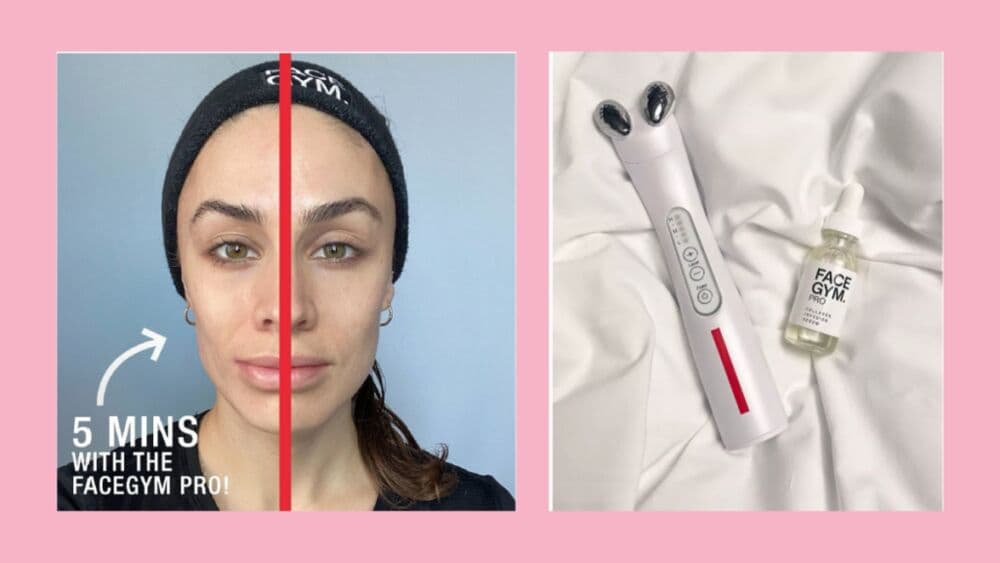
 FaceGym feature ↗
 Triple-Wave review ↗
 FaceGym Pro feature ↗
 FaceGym Pro pick ↗
 Pro week-long test ↗
 PureLift sculpting feature ↗
 Travel-friendly device feature ↗
 Beauty editor gift guide ↗
 EMS device roundup ↗
 PureLift editorial feature ↗
 EMS facial test ↗
These articles describe the original Japan-built device. We link them so you can confirm that yourself. They do not describe the 2026 rebuild.
Signal
One name.Two machines.
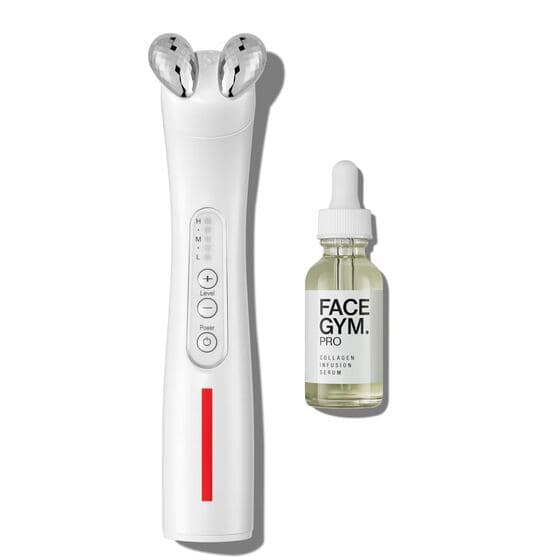
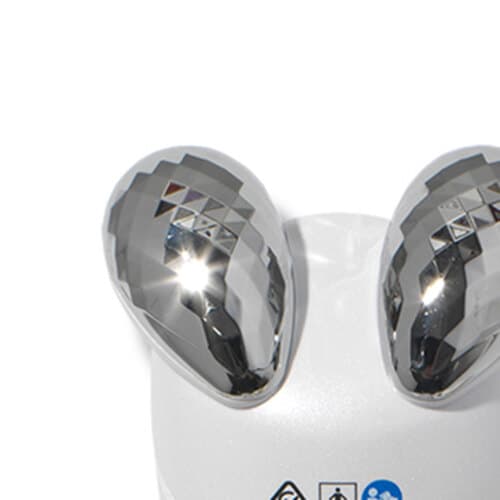 Probe head · real photo · diamond-faceted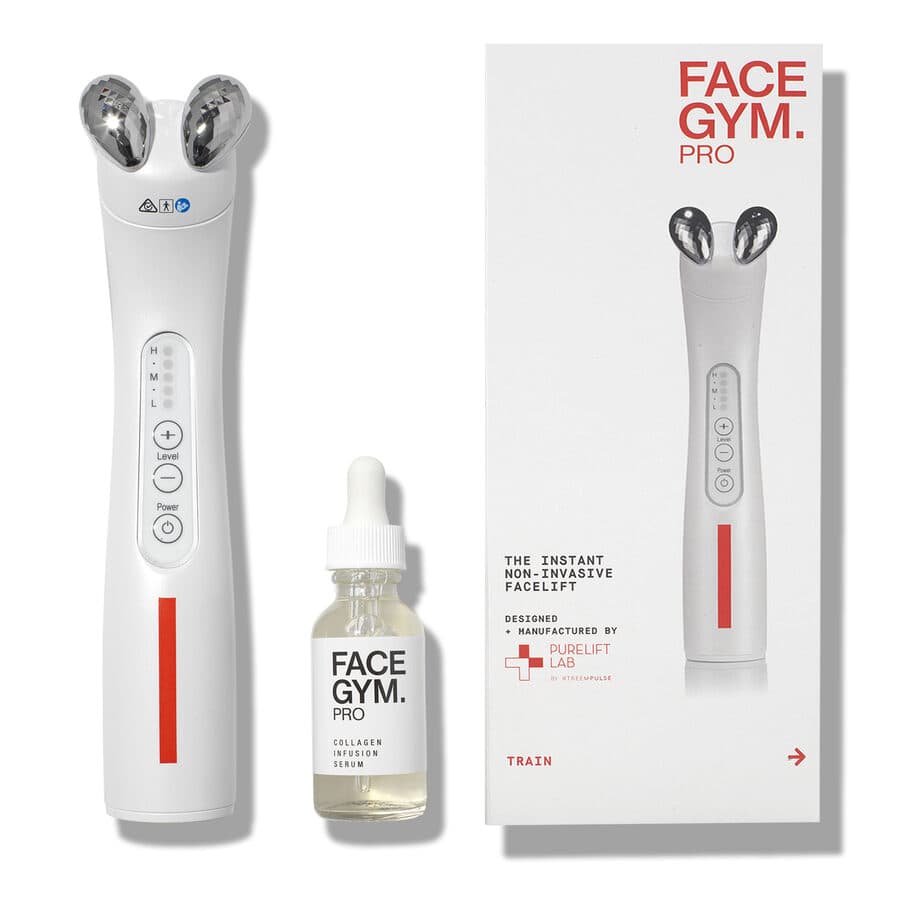
Original FaceGym Pro · made in Japan
The original
- Made inJapan · ISO 13485
- MakerThe PureLift Lab, per FaceGym
- Signal1,370–1,730 Hz, modulated
- ModulationTriple-Wave · 361 frequencies
- ProbeDiamond-faceted steel
- Power levelsGraduated
- RegulatoryFDA 510(k) Class II
- Price~£515 (as sold 2019–2025)
- Warranty12 + 6 months
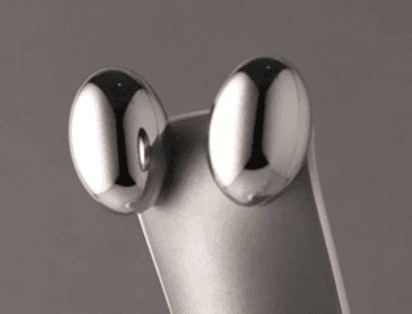 Probe head · real photo · smooth
New FaceGym Pro · made in China
The rebuild
- Made inChina (Shenzhen)
- ManufacturerShenzhen Light Tree Ventures Medical Tech Co.
- SignalFixed, up to 1.5 kHz
- ModulationNone stated
- ProbeSmooth head
- Power levels10
- RegulatoryCE / UKCA
- Price£500 / ~$673
- Warranty12 months
Both are genuine EMS, a category above microcurrent. That isn't the split. The split is fixed versus modulated current, and the Japanese one carries another company's name on FaceGym's own product page.
The split
The one the reviews praised.
- 1,370–1,730 Hz, modulated
- Triple-Wave · 361 random frequencies
- Diamond-faceted steel probe
- FDA 510(k) · ISO 13485
The one now in the box.
- Fixed current, up to 1.5 kHz
- Modulation: none stated
- Smooth head
- CE / UKCA
Did you know
Three things no listing will tell you.
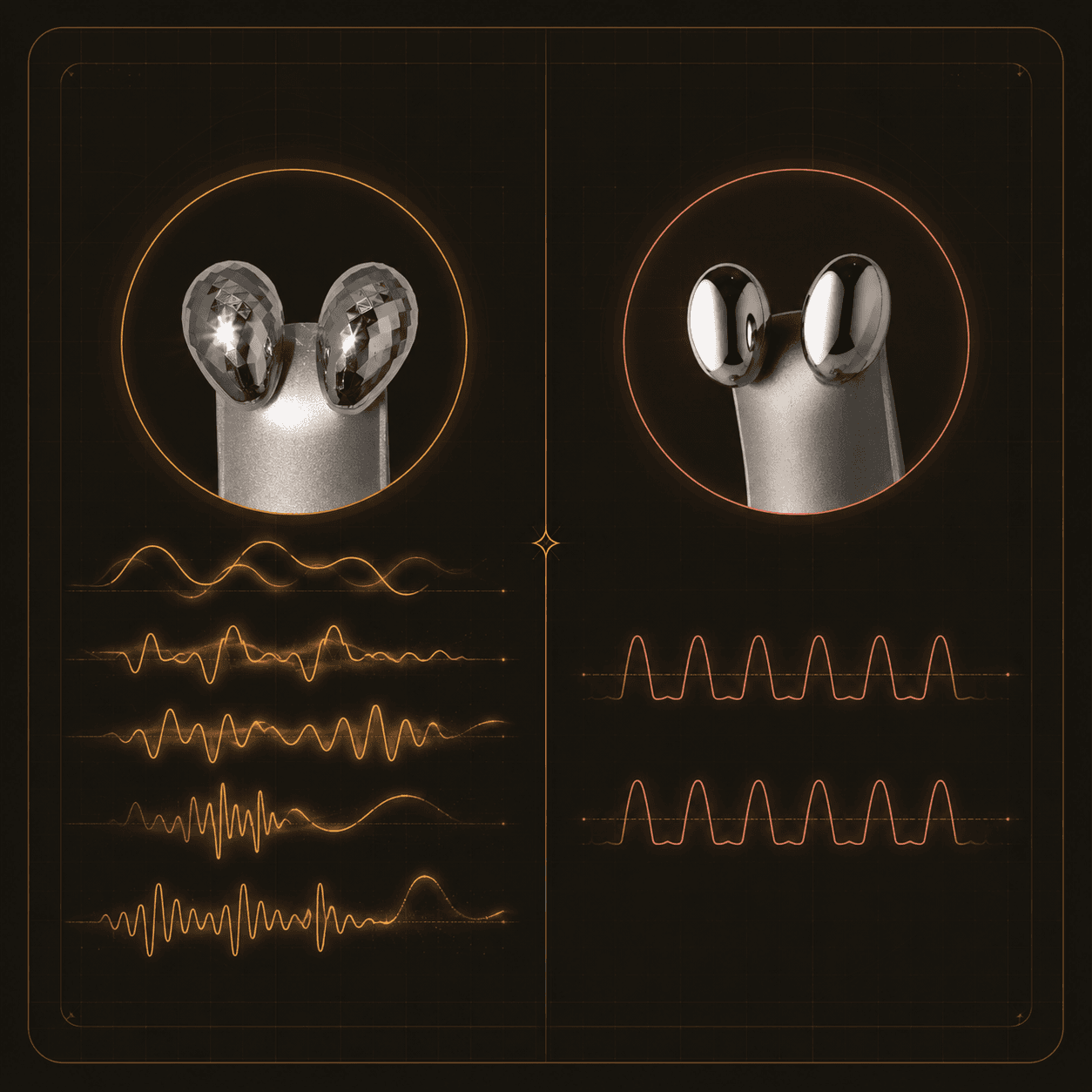
361vs1
Frequencies in play
The original never repeats itself.
361 randomised frequencies against one fixed pattern. A muscle learns a repeating signal within weeks, that's accommodation, and stops responding. A signal that never repeats can't be learned.
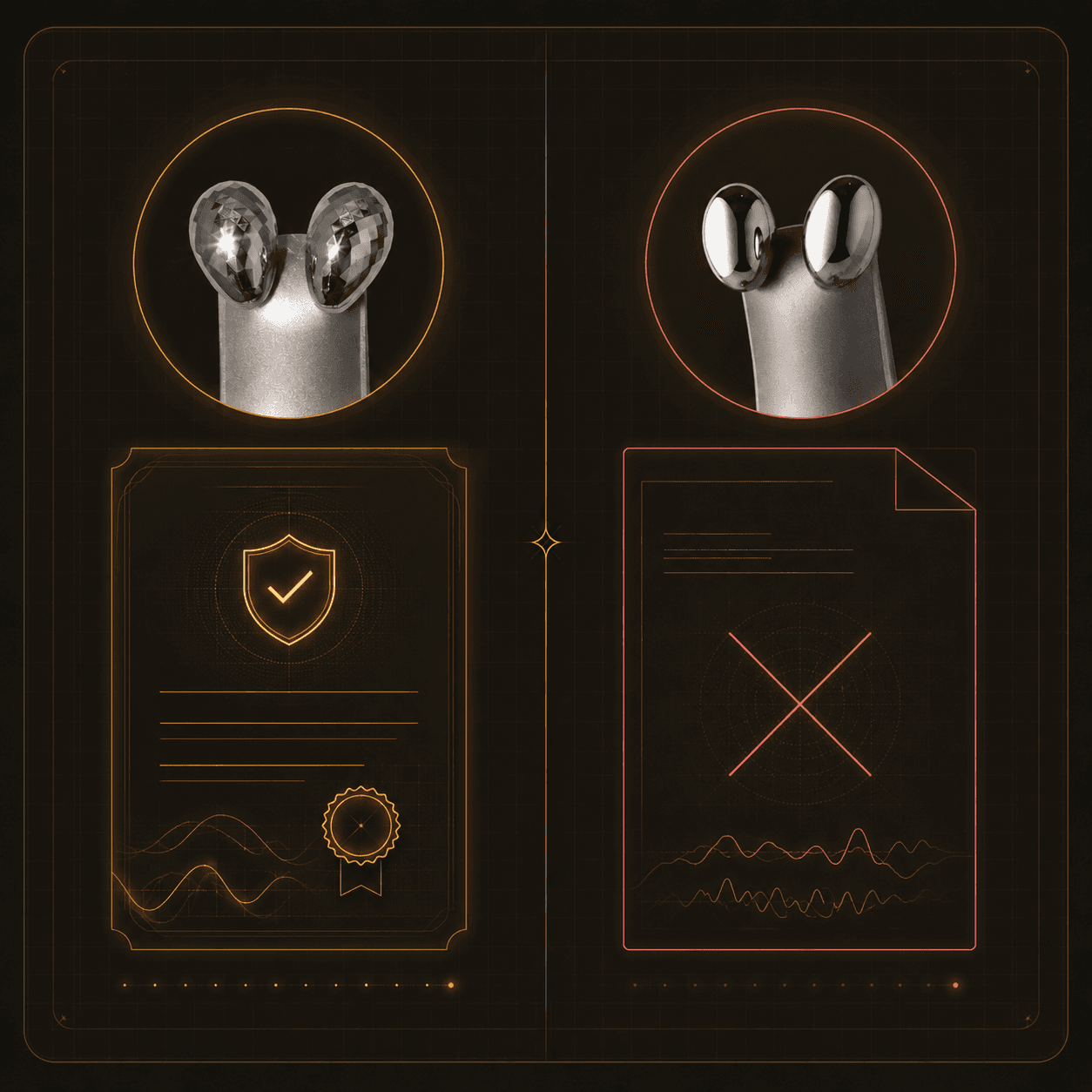
FDA 510(k)·CE / UKCA
Regulatory routes
Two markets, two regulatory routes.
The original additionally held FDA 510(k) Class II clearance for the US market and was built to the ISO 13485 standard. The 2026 device carries CE / UKCA marking — the standard, valid conformity route for an over-the-counter cosmetic EMS device in the UK and EU. The difference is which markets each was cleared for, not that one is approved and the other is not.

◆vs●
Contact head
The probe changed: faceted to smooth.
The original's packaging described its diamond-faceted probe as "greater in strength than a typical round smooth head." The 2026 device uses a smooth head. We quote FaceGym's own wording and show both probe types so you can judge.
Evidence
Made in China. It's on the box.
Not an accusation, a label. This is what's printed on the retail packaging of the 2026 device.
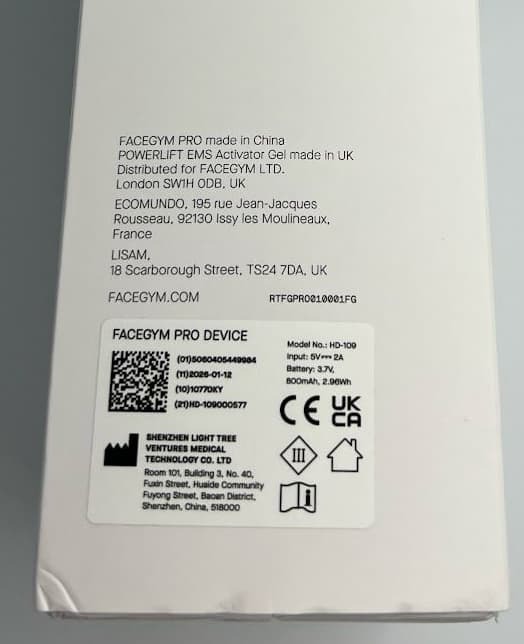
What changed on the back of the box.
Same name on the front. A different device on the back, in FaceGym's own packaging text.
Lineage
Who made the original? FaceGym already told you.
Nothing to argue here, it's on their own pages. By FaceGym's own description, the original Pro was built by The PureLift Lab in Japan. The 2026 device names a different maker, in a different country. Here are the receipts, in their words.
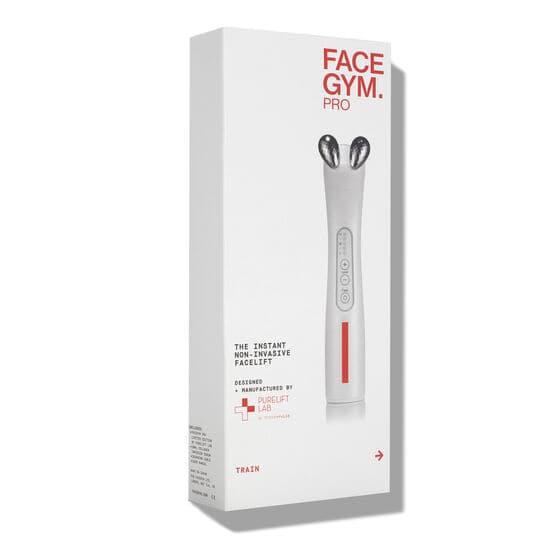
Exhibit A · The original box itself
Printed on the box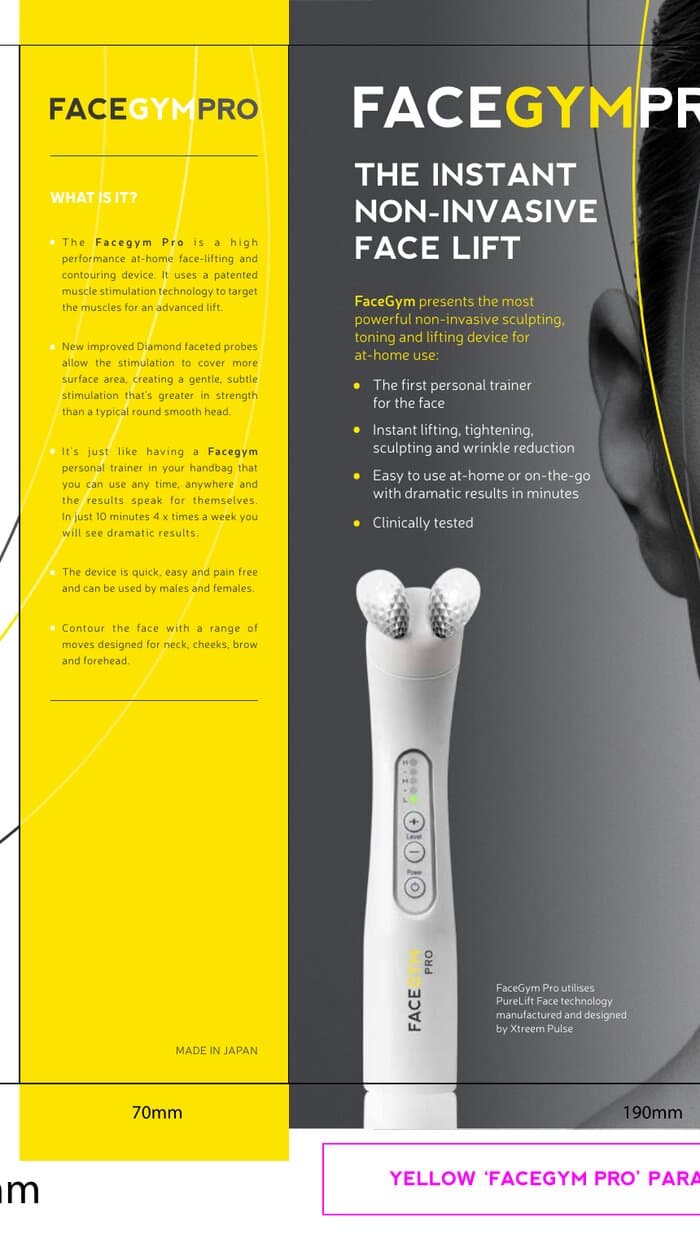
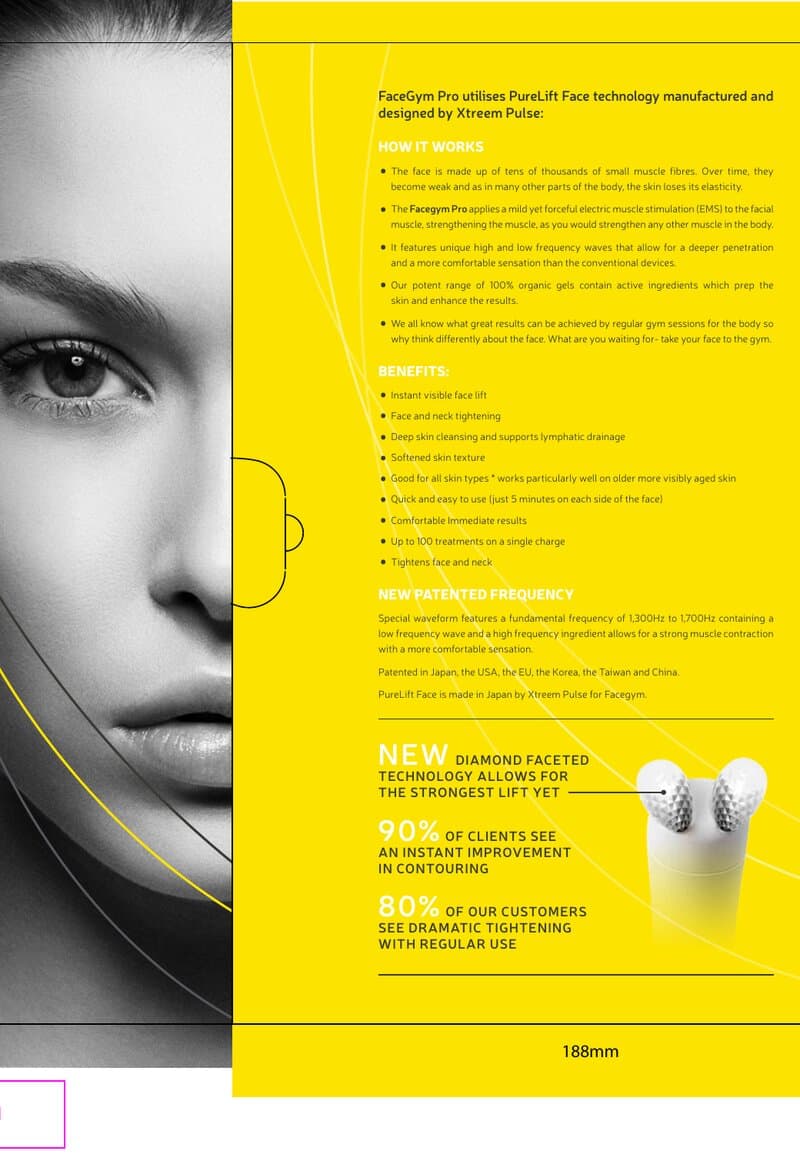
“FaceGym Pro utilises PureLift Face technology manufactured and designed by Xtreem Pulse.”
“PureLift Face is made in Japan by Xtreem Pulse for Facegym.” · “New improved diamond faceted probes… greater in strength than a typical round smooth head.”
FaceGym's own original packaging, verbatim (2019–2025).
Receipt 01 · FaceGym's US store
A page FaceGym titles “PureLift Pro”, its Triple-Wave action “cannot be duplicated… global patents”, describing the FaceGym Pro with diamond probes.
usa.facegym.comReceipt 02 · FaceGym help desk
FaceGym's own help desk calls it “the FACEGYM Pro by The PureLift Lab.”
facegym help · articleReceipt 03 · MECCA (Australia)
“FACEGYM Pro by Purelift Lab uses patented triple-wave… completely randomised.”
mecca.com.auEvidence
The whole world still sells the old one.
Major retailers across the UK, US and Australia still describe the FaceGym Pro with the original specs, triple-wave, randomised, diamond probe, patented delivery. That is the device the market believes it is buying. The 2026 China-made device does not match those descriptions. So the name on the new box does not guarantee the specs in these listings, which is exactly the confusion this page exists to clear up.
MECCA · Australia
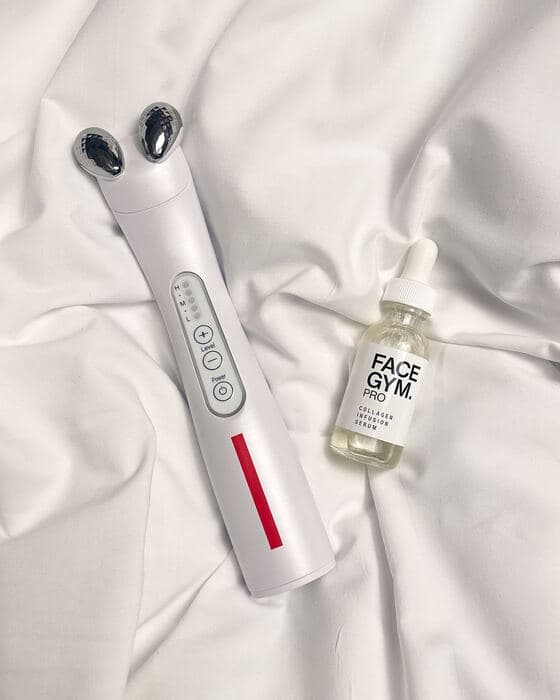
“FACEGYM Pro by Purelift Lab uses patented triple-wave… completely randomised.”
mecca.com.au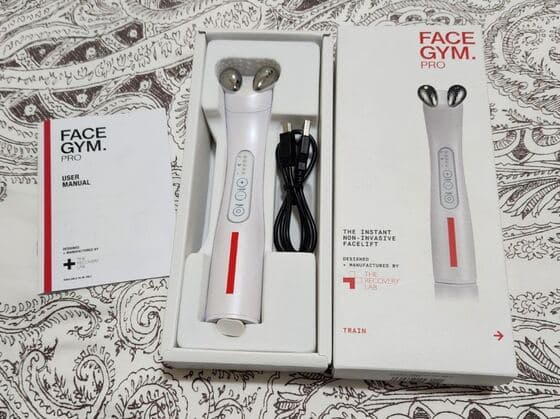
Lookfantastic · UK
“Triple-Wave technology, sending randomised pulsing currents… patented diamond-shaped delivery system.”
lookfantastic.comSpace NK · UK/US
“Randomised electrical impulses… patented triple-wave… high frequency targets muscles, medium the dermis, low an anaesthetic effect.”
spacenk.comFaceGym's own US store

Still sells a page titled “PureLift Pro,” and describes the FaceGym Pro with diamond probes.
usa.facegym.comSignal
Fixed signals fade.
Modulated ones don't.
A muscle learns a fixed, repeating pattern and stops responding to it, neural accommodation. A signal that never repeats can't be learned, so the response holds. This is the whole argument, and it rests on frequency, not amperage.
Beat 01 · independent
16 peer-reviewed trials, 1991–2024
Across the literature, varied / modulated-frequency stimulation outperformed fixed-frequency for sustained muscle output.
Beat 02 · independent RCT
Avendaño-Coy et al., 2019
Randomised, double-blind crossover trial: frequency modulation reduced habituation, users needed to raise intensity less often as the body adapted.
Beat 03 · independent
Hz, not mA
Behringer 2016 & Maffiuletti 2018: frequency, not amplitude, drives fatigue and response. The argument never rested on amperage.
Origin
Most devices never reach the muscle.
Microcurrent
Millionths of an amp. Works at the skin surface only, too weak to contract muscle.
EMS, where both Pros live
Thousandths of an amp. Reaches the motor nerves and contracts muscle. Both FaceGym Pros are genuine EMS, a category above microcurrent.
Frequency, the deciding factor
Once you're contracting muscle, frequency decides whether it keeps responding past week two. Fixed vs modulated is the whole game.
Signal
A harder pull is a shallower one.
The device that feels strongest isn't doing the most work. A bigger surface tug often means the current is staying near the skin.
Modulated signal
Contraction–relaxation cycles
A modulated carrier cycles between contraction and release. It reaches deeper, registers as lower perceived intensity, and lets you sustain a higher usable output for the full session, steady micro-contractions rather than one big pull.
Fixed signal
Sustained surface pull
A fixed carrier holds the muscle in one continuous contraction. It feels intense, a strong "tug" on the cheeks and jawline, but that sensory pull tends to stay shallow, and it caps how long the intensity stays comfortable.
Evidence
FaceGym's evidence: one study it paid for.
Modulation's evidence: 16 independent trials.
Ask one question of every claim: who paid for the proof? FaceGym's numbers for the new Pro come from a single 14-day study of 25 people, commissioned by FaceGym, shown in full, right. The case for a modulated signal comes from 16 peer-reviewed trials, 1991–2024, none funded by a device maker, left.
Independent · peer-reviewed · what a modulated signal delivers
Funded by no device maker, the proven case for the original's randomised, modulated signal.
Brand-funded · FaceGym 2026 · the new device
14 days · n=25 · 5×/week. Reported by FaceGym; shown here in full and fairly.
Buyer's checklist
Five questions. Ask them all.
Buying any "FaceGym Pro", new, old stock, or resale? These five answers identify exactly which machine you're getting. If a seller can't answer them, that's your answer.
- 01
Which FaceGym Pro is this, Japan or China?
The name won't tell you; the box will. Ask the seller for a photo of the rear label. "Made in Japan" = the original (2019–2025). "Made in China · Shenzhen Light Tree Ventures" = the 2026 rebuild.
- 02
Is the signal modulated or fixed?
The original: 1,370–1,730 Hz, randomised Triple-Wave, the muscle can't adapt. The new one: fixed, up to 1.5 kHz, no modulation stated. This is the spec that decides whether results hold past week two.
- 03
Diamond-faceted probes or a smooth head?
You can see this in any listing photo. Faceted steel probes = the original. Smooth chrome head = the 2026 device. FaceGym's own original box called the facets "greater in strength than a typical round smooth head."
- 04
Which clearance is printed on it?
FDA 510(k) Class II = the original, made to ISO 13485. CE / UKCA only = the new one. It's printed next to the model number.
- 05
Is it safe for you?
Both are over-the-counter cosmetic EMS tools, not medical treatments. Do not use during pregnancy, with a pacemaker or metal implants, or over active skin cancer or broken skin. Consult a clinician if unsure.
Compare
Both Pros. One table.
| Spec | Original FaceGym Pro Japan · 2019–2025 | New FaceGym Pro China · 2026 |
|---|---|---|
| Genuine EMS | Yes | Yes |
| Made in | Japan · ISO 13485 | China (Shenzhen) |
| Maker | The PureLift Lab, per FaceGym | Shenzhen Light Tree Ventures |
| Signal | 1,370–1,730 Hz, modulated | Fixed, up to 1.5 kHz |
| Modulation | Triple-Wave · 361 random frequencies | None stated |
| Probe | Diamond-faceted steel | Smooth head |
| Power levels | Graduated | 10 |
| Clearance | FDA 510(k) Class II | CE / UKCA |
| Warranty | 12 + 6 months | 12 months |
| Price | ~£515 (2019–2025) | £500 / ~$673 |
Independent research (Behringer 2016; Maffiuletti 2018) shows frequency, not amplitude, drives the response. Specs reflect FaceGym's and major retailers' published listings, current as of June 2026, verify before purchase.
Price check
Same price. Not the same machine.
FaceGym's new Pro costs essentially what the original did. The price carried over. The machine didn't.
If a listing can't tell you which machine you're getting, ask before you pay, the five questions above help.
On the record
No one has run these devices head-to-head in a clinic. We won't pretend otherwise.
The claims here are category-level and research-anchored, not a direct clinical face-off between these two exact units. And where the new FaceGym Pro is genuinely good, we'll say so: it is real EMS, it beats microcurrent, and it may feel stronger in the hand. The goal of this page is your informed decision, not winning an argument.
FAQ
No spin. Just answers.
Is this an independent review?
This is an independent comparison operated by LARA Media Group (United Kingdom). It is not affiliated with, authorised by, or endorsed by FaceGym Ltd. We've built it as an evidence-led buyer's guide, with every factual claim linked to FaceGym's own pages, major retailers, independent press, or peer-reviewed journals so you can check the work yourself.
Who made the original FaceGym Pro?
By FaceGym's own description: The PureLift Lab. FaceGym's US store hosts a page titled "PureLift Pro," its help desk calls it "the FACEGYM Pro by The PureLift Lab," and MECCA describes the "FACEGYM Pro by Purelift Lab." We carry the relationship only through their words and major retailers' words, all linked above.
Where's the proof it's made in China?
On the box. The 2026 retail packaging lists Shenzhen Light Tree Ventures Medical Technology Co. Ltd, Baoan District, Shenzhen, China 518000, model HD-109. The activator gel is UK-made; the device itself is China-made.
Can I still buy the original?
FaceGym no longer sells the Japanese-made device, its run ended in 2025. The maker still manufactures the same technology under its own name; per our disclosure below, we won't pitch it here. What matters for this page is simpler: the 2026 FaceGym Pro is not the same machine the reviews praised.
Is EMS safe for me?
EMS facial devices are over-the-counter cosmetic tools, not medical treatments. Do not use during pregnancy, with a pacemaker or metal implants, or over active skin cancer or broken skin. If you have any medical condition or are unsure, consult a clinician before use.
What actually changed between the original and the 2026 model?
The original (2019–2025) was made in Japan, used PDM modulated frequency across 361 distinct points, and carried an FDA 510(k) clearance. The 2026 model is made in China, uses a fixed single frequency up to 1.5 kHz, and carries CE/UKCA marking. Same name, different signal architecture, different origin.
Does the new FaceGym Pro still use Triple-Wave / randomised current?
No. The original's Triple-Wave technology — the proprietary architecture targeting three muscle depths simultaneously via randomised modulation — does not appear on FaceGym's 2026 product page. The new device is described as having "low, medium and high frequencies" but without the randomised modulation that defined the original's engineering.
Is the new FaceGym Pro FDA cleared?
The new 2026 device carries CE/UKCA conformity marking for the UK and EU markets. The original device additionally held FDA 510(k) Class II clearance for the US market. Both are valid regulatory paths for over-the-counter cosmetic EMS devices; the difference is which markets each was cleared for, not that one is approved and the other is not.
Why does my FaceGym Pro feel weaker or different than reviews described?
If you purchased after April 2026, you may have the new China-built model. Reviewers praised the original's modulated signal; the new fixed-frequency design has different sensation and contraction pattern. Check your box: if it lists Shenzhen Light Tree Ventures as manufacturer (model HD-109), you have the 2026 rebuild, not the original.
Is FaceGym Pro the same as PureLift?
For seven years (2019–2025), the FaceGym Pro sold was manufactured by the PureLift Lab and ran PureLift's proprietary PDM technology. Since April 2026, FaceGym has rebuilt the device in-house in China. The original FaceGym Pro and current PureLift devices share the same engineering lineage; the current FaceGym Pro does not.